
Clover Food Lab: Fast Food That鈥檚 Good For You
How Clover's innovative processes enable the company to offer healthy fast food to customers

(Image Source:听https://www.bostonglobe.com/magazine/2014/07/28/clover-food-lab-secret-ingredient-data-lots/JvSdzaodIny9A6xQzYdrPL/story.html)
Clover Food Lab, a Boston-based fast-casual restaurant and foodtruck chain, was founded with the mission to reduce meat consumption by offering delicious, healthy vegetarian meals in convenient settings to change what carnivores eat. By linking their business and operational models tightly, Clover is able to execute on its promise and drive superior customer loyalty: 鈥溾��90 percent of first-timers return within four weeks and 1 in 4 customers visits more than once a day.鈥� 1
Customer Promise & Business Model

There are three main aspects of Clover鈥檚 business model that drive such strong customer loyalty:
- Delicious, healthy food 鈥� 鈥淲hen people go to Clover, they don’t expect the same burger and fries, they expect good food.鈥�3 Ayr Muir, Clover鈥檚 co-founder, describes 鈥渃lean flavors鈥�2 as the defining feature of the restaurant鈥檚 food philosophy. This means simple, delicious meals cooked from scratch (Clover only uses pre-packaged ketchup and mayo ingredients).
- Fast, convenient service 鈥� At Clover, the lines move fast and customers never have to wait long for their order. Muir notes that Clover is 鈥渙bsessed with speed鈥�, with average service times of 3.5 minutes, just a bit longer than at McDonald鈥檚.2 If something goes wrong, the staff goes out of their way to help and Muir is known for issuing public apologies on his blog (most recently, he expressed regret over a 鈥渞eally screwed up鈥� Broccoli Strawberry sandwich4).
- Social mission 鈥� Clover is a mission-driven organization. Beyond helping the environment through reducing meat consumption, the restaurant also wants to support the communities it operates in by sourcing local ingredients,1听raising employee minimum wage and engaging its customers in every major decision (such as new menu offerings).5
听
Operating Model
Muir notes that 鈥�the way we operate is unheard of in our industry鈥�.2 Every aspects of the operating model, from recipe development to supply chain management, have been designed to ensure the customer promise described above is fulfilled.
Recipe Development
(Image Source:听http://www.confessionsofachocoholic.com/healthy/clover-now-open-in-harvard-square)听
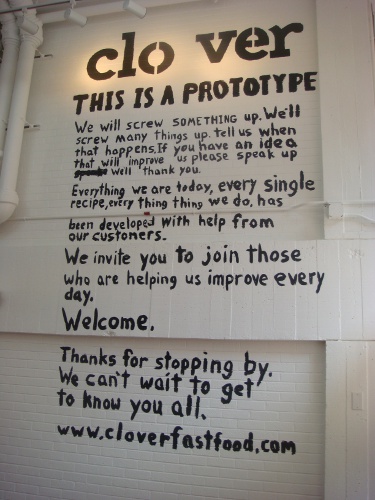
Clover uses a听crowdsourcing process to generate ideas and select new recipes for its restaurants. In addition to online idea submissions page, the restaurant also hosts public Food Development Meetings every Tuesday, where customers and Clover staff can present new recipes for evaluation.3 Attendees, including Muir, provide feedback and the best ones move on to further rounds of evaluations and pilots, before finally being incorporated into the menu.
However, existing menu items are still closely monitored and updated based on customer feedback. The iconic chickpea fritter sandwich recipe has been updated over 30 times since it was first introduced 7 years ago.3
This crowdsourced, iterative and test-driven approach to recipe development ensures the continuous improvement of the menu and high customer engagement, setting Clover apart from its competitors.
Food Preparation
To ensure 鈥渃lean flavors鈥�, the staff prepares all recipes from scratch. Everything is extremely fresh – they do not use preservatives or even freezers and make sure to cut the ingredients as close to the consumption time as possible.2
As a result, the menu is small, changes frequently based on available ingredients and items occasionally run out. 鈥�We choose to run out鈥�2 says Muir – an unavoidable consequence of being uncompromising on food freshness and quality.
Supply Chain Management
Clover sources 40-85% of ingredients locally 2 to further support their social mission and 鈥渒eep your money in your region鈥�, as well as ensure 鈥渃lean flavors鈥� and fresh ingredients. Over time, Clover has developed close relationships with distributors and suppliers, enabling the team to be even more discerning about which ingredients to offer when.
Technology
Technology is paramount to achieve superior customer service and high employee wages. Trainings are offered via Youtube, shifts are scheduled through a cloud-based system, customer orders are taken by iPhone and plants water themselves (to save employees time).1
Gathering and analyzing feedback to improve operations is also of great importance at Clover. 鈥淎lmost anything that happens at Clover is gauged, tracked, and beamed through the cloud to management in real time鈥�1. Clover analyzes over 3,000 comments a month, gathering data during order processing, as well as through customer surveys, Twitter, Yelp and Facebook.3 This data is used to measure how well the company is tracking against its customer promise and allows management to make changes if any gaps are identified.
Muir has grand growth aspirations: 鈥淚 think we should be as big as McDonald鈥檚 one day鈥�.3听But Clover works because of the听tight link between the business and operating models. Whether this link can be replicated on a national, or even international, scale remains to be seen.
Sources:
[1]
[2]
[3]
[4]
[5]
Great write-up on Clover! You clearly link the operational and business strategies. iPhone ordering and automated plant watering free up employees to make the food faster; local ingredients and a willingness to run out of ingredients lead to delicious, healthy food.
In reading this, I had a few questions:
1) With high wages and lots of technology (and technology costs), what does that mean for Clover’s food prices? Are they high?
2) Are some customers frustrated by the lack of consistency in food? (No set menu, changes in recipes, certain things running out).
3) With regards to your final question about whether the Clover strategy could be replicated, I have an additional question. Are there many customers with demand for Clover’s customer promise / value proposition outside Boston? It makes sense that there is a customer base in a health conscious city like Boston, but I’d be curious if there is similar interest in other areas.
As Clover fan, I really appreciate this post. Even thought I have been to Clover many times, I had not idea that their operations system is so great and integrated into their value proposition. After reading this article it all makes so much sense. Clover has definitely incorporated many of the operations themes we have covered in class – from developing their menu through ideation and customer input, to using data to track menu items and customer purchases. One aspect that I find particularly interesting is that Clover not only incorporates their values of speed and clean taste into their operations, but they include their social impact goals as well. As someone who is interested in how the private sector can become more socially oriented, I can now see the value in how companies can use operations standards to create a positive impact on the communities they are a part of. Clover uses their relationships with distributors and focus on local produce to create an impact. Do you know if Clover has a way of tracking this social impact? I think that if they could more directly track their impact as well, they could help promote social enterprise.
Huge fan of Clover! This post was very insightful, thanks. I had no idea that their recipes were crowd-sourced, but given the high quality, definetely makes sense. I wonder if they could ever become as big as McDonald’s though. I highly doubt it because for one, they would likely not have access to enough supply of ingrediants. Unlike McDonalds, their ingredients are all natural. It’s hard to source such materials–when McDonald’s adds an ingredient to a salad it has to manipulate global supply of that ingredient. Additionally, McDonald’s appeals to a much larger client base due to its lower price points.
As long as I have a Clover near me, no need for them to be the next McDonald’s!