
The 45th: How the Trump Campaign鈥檚 Digital Strategy Made History

Trump’s Innovative and Effective Digital Campaign
Shock
On November 8, 2016, Donald Trump shocked the world. In the days and months leading up to the presidential election, almost every public and private metric suggested Trump was heading for a loss, potentially of epic proportions. Nearly every forecaster projected that Hillary Clinton would be elected as the next President. And yet, over the course of the evening, pollsters, the American political establishment, and voters were stunned as they began to realize that Donald Trump would be named the 45th President of the United States.
| Win presidency |
[1]

How did Trump, whose entrance into the Republican Primary was widely considered laughable and whose ascendance to the nomination was considered a gift by the Democratic Party, win 306 Electoral Votes and capture an election that was considered to belong to Clinton? By employing an incredibly powerful and innovative digital strategy never seen in a global election that outmatched the Clinton campaign and caught political pundits completely by surprise.
While the Clinton campaign employed a robust digital strategy, investing nearly $30 million in digital ads in the weeks leading up to the election [2], the Trump campaign spent ~$70 million per month on digital operations, much of it to cultivate a universe of fervent Trump supporters, and in the final weeks of the campaign, to suppress potential supporters of Hillary Clinton. [3]
鈥淔acebook and Twitter were the reason we won this thing鈥�, Brad Parscale [2]
San Antonio
Led by Brad Parscale, the Trump campaign鈥檚 digital operations team was composed of ~100 staffers and headquartered in San Antonio, Texas. A mix of programmers, network engineers, and data scientists, this group deployed a devastatingly effective digital strategy comprised of three elements: big data analytics, OCEAN model behavioral science, and ad targeting.
Following Trump鈥檚 official nomination as the Republican Party candidate, Parscale began building database of potential Trump supporters. This work ultimately resulted in Project Alamo, a proprietary database (now owned by Trump), which contains the identities of 220 million people in the US, ~4,000-5,000 individual data points about the online and offline life of each person [3]. After Project Alamo鈥檚 completion, Parscale added vast quantities of external data, including voter registration records, gun ownership records, credit card purchase histories, and internet account identities which Trump campaign was able to purchase from certified Facebook marketing partners Experian PLC, Datalogix, Epsilon, and Acxiom Corporation.
Working with Cambridge Analytica, a data consultancy firm, the Trump campaign leveraged the work of Cambridge psychologist Michal Kosinski to target audiences with specific messaging and ads using psychographics, the measurement of psychological traits, via the OCEAN model.
| Openness | How open are you to new experiences? |
| Conscientiousness | How much of a perfectionist are you? |
| Extroversion | How sociable are you? |
| Agreeableness | How considerate and cooperative are you? |
| Neuroticism | Are you easily upset? |
听摆4闭
Compared to demographic targeting, Kosinski鈥檚 study at Stanford has shown 鈥渢he effectiveness of personality targeting by showing that marketers can attract up to 63% more clicks and up to 1,400 more conversions in real-life advertising campaigns on Facebook when matching products and marketing messages to consumers’ personality characteristics鈥� [4].
鈥淒igital strategists typically value contact lists at $3 to $8 per e-mail, which would price Trump鈥檚 list of supporters anywhere from $36聽million to $112聽million.鈥� [5]
Dark Posts
Armed with this vast database of voter information and advanced psychographic targeting techniques, the Trump campaign utilized basic Facebook analytical tools such as Custom Audiences, Audience Targeting Options, Lookalike Audiences, and Brand Lift to deploy highly specific campaign messaging to influence undecided voters to an extent never seen before in a political campaign.
Over the course of the general election campaign, Trump鈥檚 digital team built or generated more than 100,000 distinct pieces of creative content [3]. Trump鈥檚 digital machine drove fundraising efforts, ultimately collecting $275 million in donations through Facebook [3], dictated appearances based on where the largest clusters of persuadable voters resided, and led efforts in both electorate expansion (for potential Trump supporters) and suppression (for potential Clinton supporters).
鈥淲e have three major voter suppression operations under way,鈥� said a senior Trump official. They鈥檙e aimed at three groups Clinton needs to win overwhelmingly: idealistic white liberals, young women, and African Americans鈥� [5]. Using 鈥渄ark posts鈥�, nonpublic paid post shown only to selected Facebook users, the campaign spent $150mm on Facebook and Instagram advertisements in final weeks of election that negatively portrayed Clinton to discourage voter turnout [3].
The goal was to depress Hillary Clinton鈥檚 vote total. 鈥淲e know because we鈥檝e modeled this,鈥� said a senior Trump official, 鈥渋t will dramatically affect her ability to turn these people out鈥� [5].
Builder
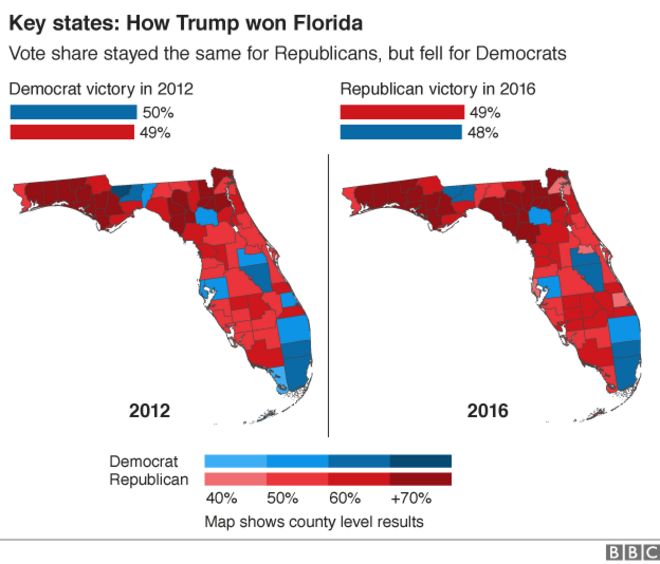
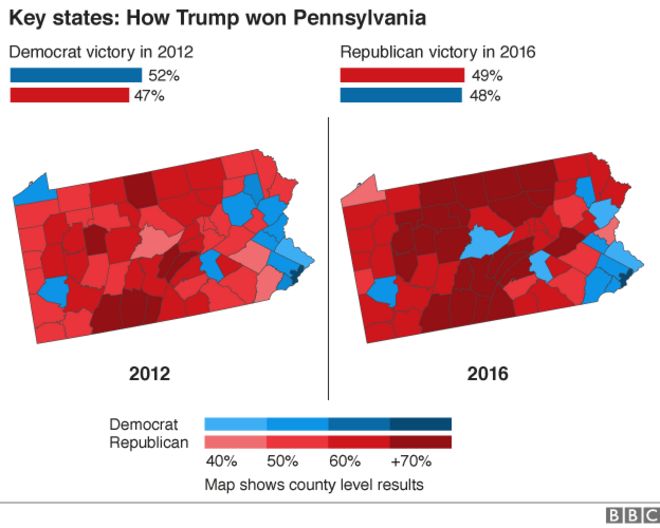
In the final months of the campaign, it looked like Trump was being outspent by Clinton, whose campaign put $200 million into television ads leading up to the election, more than double that of the former [2]. However, this was not the case, as the Trump campaign was merely focusing its efforts online.聽Ultimately, the Trump campaign鈥檚 decision to bet on micro-targeted Facebook ads worked, as Democratic turnout in battleground states was 鈥渟urprisingly weak, especially among sporadic and first-time voters鈥� [3]. In fact, the decision to focus on Michigan and Wisconsin in the final weeks of the campaign was made directly as a result of the campaign鈥檚 digital focus. Based on comments from David Plouffe, President Obama鈥檚 2008 campaign manager, one can see that Clinton鈥檚 slim losses in Detroit and Milwaukee counties cost her the states of Michigan and Wisconsin, respectively [3].
| County (State) | Romney Vote Differential vs Obama in 2012 | Clinton Votes Needed to Win State in 2016 |
| Detroit (Michigan) | -70,000 | 12,000 |
| Milwaukee (Wisconsin) | -40,000 | 27,000 |
[3]
In several key battleground states, the Trump campaign鈥檚 focus on data analytics and voter targeting allowed it to determine which messages worked best and where, carry the vote in states that President Obama had won just four years prior,聽and in the end, win the Electoral College vote to become the 45th President of the United States.
鈥淭rump is a builder,鈥� says [Steve] Bannon. 鈥淎nd what he鈥檚 built is the underlying apparatus for a political movement that鈥檚 going to propel us to victory on Nov.聽8 and dominate Republican politics after that.鈥� [5]
 听摆6闭
听摆6闭
 听摆6闭
听摆6闭
 听摆6闭
听摆6闭
References
[1] Katz, Josh. “Who Will Be President.”聽New York Times. November 8, 2016. .
[2] Lapowsky, Issie. 鈥淗ere鈥檚 How Facebook Actually Won Trump The Presidency.鈥� Wired. November 15, 2016. .
[3] Winston, Joel. 鈥淗ow the Trump Campaign Built an Identity Database and Used Facebook Ads to Win the聽Election.鈥� Medium. November 18, 2016. .
[4] Grassegger, Hannes and Mikael Krogerus. 鈥淭he Data That Turned the World Upside Down.鈥� Motherboard. January 28, 2017. .
[5] Green, Joshua and Sasha Issenberg. 鈥淚nside the Trump Bunker, With Days to Go.鈥� Bloomberg Businessweek. October 27, 2016. .
[6] 鈥淯S Election 2016: Trump victory in maps.鈥� BBC News. December 1, 2016. .
Thx for this post 鈥� was glad to see it here.
I am curious to know what you think about the way that all of the different content formats Trump employed, in addition to highly refined ad targeting and “dark posts”, also contributed to Trump’s digital strategy. Pew did some research* which found that Clinton, Sanders, and Trump were all posting online at similar rates, for example, but that Trump consistently received a bigger response to his posts 鈥撀爈eading to greater virality, more earned media.
Do you think that content types and formats played a role, or was Trump’s team just better at making the ads work for him?
*http://pewrsr.ch/2k4NsJ9
Although the digital marketing employed by Trump’s campaign team was data-backed, calculated, and strategic there were a number of other things that happened too like an unprecedented featuring of fake or misleading news on Google and Facebook, and a braggadocious candidate that captivated the media and gained incredible amounts of airtime. How much of his success would you attribute to the digital marketing alone? Do you think future candidates will copy the digital strategy that was employed here?
There’s been a lot of press around Trump’s digital efforts. There seems to be less clarity on the tactics the Clinton campaign was employing on the web, or at least there has been less reporting. Do we know, for instance, that the Clinton Campaign didn’t have a database similar to Project Alamo? The impression I’ve gotten when speaking to Clinton people is that they were employing all the same tools. Dollars invested aside (since this figure is somewhat unclear), can we say for sure that Brad and his team were doing something entirely novel, AND that this delivered Trump the election?
Ian – I really enjoyed reading this assessment. Although on the surface it seemed their campaign was flying blind, they did have a digital strategy in place. I’m wondering how this continues after the campaign, especially given Trump’s erratic remarks on social media. Do you think his digital targeting strategy can or should change now that he’s president, especially given that the content has remained relatively similar?
This is an amazing assessment and I really haven’t seen someone put together such a thoughtful analysis on President Trump’s digital strategy. Although the strategy and methodology utilized definitely seems novel as compared to past political campaigns, I can’t help but think that the similarity between victory in 2016 and President Obama’s first victory in 2008 was that both campaigns utilized digital innovations to connect with voters and convert independents, it was cited as key reasons each president won in both instances. I wonder if in the future it will become consistent that the candidate with the more advanced and higher budget digital campaign will determine election outcomes.
Thanks for sharing, Ian! I enjoyed your take. While it certainly seems that our new President’s digital strategy was simply more effective than Clinton’s, it begs the question why the media was so out of touch. If Trump could reach these voters with digital ads, how could they be entirely absent from digital polling? I’ve heard the theory on hesitant Trump supporters being afraid to voice their thoughts, but intuition says the anonymity of an online poll should alleviate some of this. I don’t think anyone has an answer to this now and I’m sure experts will spend several years further diagnosing this election but what does seem clear to me is that the media needs to be as digitally savvy as the campaigns to better reflect the nation’s collective sentiment.
Ian, great post – thank you for sharing it! If your hypothesis is true (if Trump won thanks to his data-backed, targeted marketing), this raises a serious question on the function of democracy in developed countries and the efficiency of markets. This is an interesting digital transformation case, but more importantly I think it points to a market failure. While in traditional capitalism capital is the unfair influencing mechanism, now data is acting as the weapon that distorts market equilibrium.
Ian – This is extremely interesting and eye opening.
For me, this raises a few questions about the demographics that ended up voting for Trump, and to seek their correlation to the social groups representation on social networks and were targeted by this campaign. As generally speaking Trump’s voters were older, and the younger population showed up at lower numbers, would you assume that the most gains of the digital efforts were in demotivating the Clinton’s voter base rather than increase Trump’s?
Overwhelmingly, it seemed as though Trump did not actually get more votes than Romney did in 2012, rather Clinton got less than Obama.
Thanks for the post!
-G
Hi Ian, great post. One thing I’ll add is that a major driver for this election was earned media – ie, the unsolicited sharing and distribution of content. The biggest takeaway for me about the psychographics play was that it enhanced earned media way more than Hillary’s demographic play. Because his talking points were so specifically targeted to behavior and ideologies, people felt more connected to his message and thereby more likely to share and identify with it publicly. The demographics targeting didn’t lead to this kind of personal affiliation. This very well could have led to fewer people identifying closely enough to Hilary to distribute her content and eventually, bring them to the polls.